
EARLY WARNING
Alerting and anomaly detection as a product.
Continuous awareness and early threat detection for proactive decision-making.
Early Warning composes metrics over the data you already collect, watches them with rules you write, and raises a flag when something moves — with anomaly detection covering the deviations nobody wrote a rule for.
Alert rules, anomaly detection, escalation and APIs — running inside your own environment.
What Is Early Warning?
Alerting, anomaly detection and escalation over the data you already collect.
Early Warning is our alerting product for teams that cannot watch every dashboard themselves. You describe the quantities that matter, attach the conditions that should raise an alert, and decide where a raised alert goes next — over data that stays in your environment.
01
Alert rules over your own metrics
A metric builder composes reusable metrics from measures, time dimensions, dimensions and filters. Alert rules then watch them: thresholds, percentage or absolute change, comparison periods, and a spatial radius when the location is what matters.
02
Anomaly detection that needs no rule
Every series is compared against its own recent history. Deviations are scored and ranked, so a rise in a normally quiet area surfaces even when no one has written a rule for it yet.
03
From alert to closure
A fired rule notifies the people who own the metric or opens a card on the response board it belongs to — with severity, ownership and status tracked through to closure, and a record of who did what.
Core Capabilities
Every capability runs on data you already collect, inside your own environment.
01
Metric Builder
Define a reusable metric over your data — measure, time dimension, granularity, dimensions and filters — then reuse it in rules, charts and reports. A metric is composed once and queried consistently everywhere.
02
Alert Rules
Attach conditions to a metric: a fixed threshold, a percentage change or an absolute change, compared over a day, a week or a month. Each rule carries its own message and its own notification actions.
03
Spatial Constraints
Bind a rule to geography — a radius around a place, compared like-for-like against the same area — so a rule fires on local movement rather than on regional volume. "Above five within fifty kilometres" is one rule, not a script.
04
Anomaly Detection
Baseline-aware scoring on every series, with deviation scores and severity levels for the patterns no rule covers, plus short-horizon projections of where a series is heading next.
05
Escalation Workflows
Route a fired rule to the people who act on it: an in-app notification, a card on the right response board, and an owner, category and status from first report through to closure.
06
Integration & APIs
Bring data in on a schedule, read metrics and alerts over a REST API with token authentication, export CSV or GeoJSON, and generate PDF reports — all inside infrastructure you control.
Where It Fits
Three operational problems this product was built for.
Industrial Operations
Watch production and site conditions against their own baselines, and route a deviation to the shift that can act on it while it is still small.
Utilities & Infrastructure
Keep thresholds and change rules on the assets and services you are responsible for, with alerts that carry the location and the history behind them.
Logistics & Supply Chain
Monitor flows, dwell times and chokepoints as time series, and escalate the movements that matter to the team that owns the route.
Latest from Early Warning
New features, releases and writing from this product.
NEW FEATURE
The alerting engine
Metrics you define once, rules that watch them continuously, and alerts that arrive with the context needed to act on them.
NEW FEATURE
Anomaly detection
Baseline-aware scoring that surfaces an unusual pattern before anyone has written a rule for it.
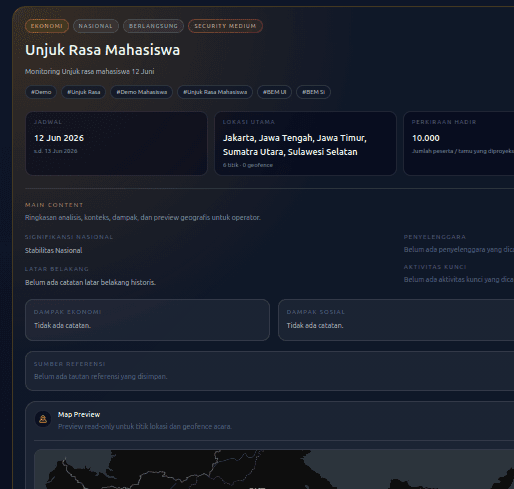
NEW FEATURE
Escalation workflows
From a fired rule to an assigned, tracked response — the path an alert takes after it fires.
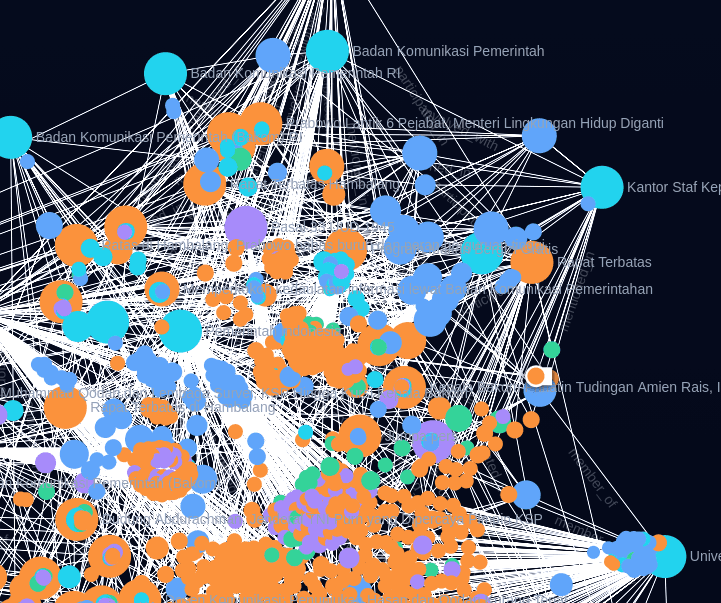
NEW FEATURE
Integration and APIs
How Early Warning fits the systems you already run: scheduled ingestion, authenticated REST access, exports and reports.
Want to see it on your data?
We run technical briefings and scoped walkthroughs. Bring the metric your team checks by hand today and we will show you the rule, the alert and the escalation path around it.